
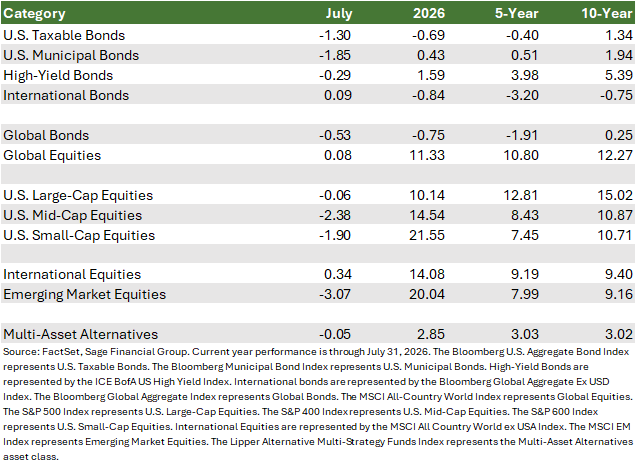
July underscored the importance of looking beyond broad market averages and the benefits of diversification. Fixed income investors demanded higher yields to absorb heavy bond issuance by both governments and companies around the world, while equity investors increasingly sought tangible evidence that AI-related spending would translate into stronger earnings and cash flow. That divergence across asset classes and within the equity market defined the month’s performance.
Monthly Market Recap
Fixed Income Markets
Bond prices broadly declined as renewed oil volatility raised inflation expectations and substantial Treasury and corporate issuance added pressure across the yield curve. Bond prices and yields move in opposite directions.
- U.S. taxable bonds declined 1.3% as longer-term Treasury yields rose despite the FOMC holding rates steady. Persistently stubborn inflation expectations and concerns over the federal deficit pushed yields higher.
- Tax-exempt bonds fell 1.9% as higher Treasury yields compounded the challenge of elevated municipal issuance amid a seasonally weak period.
- High-yield bonds declined 0.3%, holding up better than U.S. Treasuries, with the positive start to corporate earnings season keeping credit spreads tight.
- International bonds marginally rose 0.1%, supported by a weaker U.S. dollar that offset the impact of rising global bond yields.
Equity Markets
Equity returns varied widely as investors questioned the returns on AI spending and participation continued to broaden beyond the largest companies.
- U.S. large-cap equities declined approximately 0.1%, with AI-hardware stocks moving lower on capital spending concerns. Still, that weakness was more constrained than a widespread selloff as the equal-weighted S&P 500, a measure of the average U.S. large-cap stock, rose 1.0%.
- U.S. mid-cap equities declined 2.4%, as technology and industrials stocks viewed as the picks-and-shovels beneficiaries of AI were adversely impacted by uncertainty around the sustainability of future AI spending.
- U.S. small-cap equities similarly declined 1.9% and were more acutely challenged by higher rates raising the cost of debt, which weighed on less-stable balance sheets.
- International large-cap equities rose by 0.3%. At the same time, in some pockets, investors pulled back from crowded AI and semiconductor winners amid rising geopolitical tension and growing global doubts about how sustainable AI infrastructure spending is. Broad-based performance was favorable, with 9 of 11 sectors positive as earnings season had a strong start in Europe and Japan.
- Emerging market equities fell 3.1% as profit-taking in major semiconductor and memory companies was more pronounced, with two South Korean stocks comprising nearly 15% of the index driving nearly all of the negative return.
Oil Prices and Bond Supply Put Upward Pressure on Interest Rates
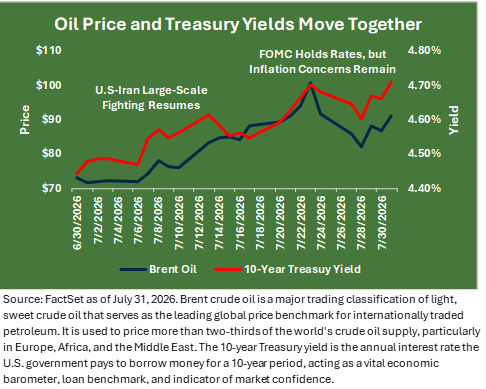
Two forces helped push long-term interest rates higher in July: rising energy prices tied to Middle East tensions and heavy Treasury and corporate bond issuance.
Oil prices entered July near pre-conflict levels as investors anticipated easing tensions in the Middle East. That reversed mid-month when the U.S. and Iran escalated hostilities, shipping through the Strait of Hormuz slowed sharply, and Brent crude briefly moved above $91 per barrel.
Oil matters because higher energy costs can flow through transportation, manufacturing, and services and lift inflation expectations even before they show up in reported inflation. In July, that inflation concern appeared to outweigh the usual safe-haven demand for Treasuries.
From a market perspective, the 10-year Treasury yield rose above 4.7% toward the end of the month. Both sides later paused direct strikes, and oil prices retreated, but the episode showed how quickly a regional event can reach broader markets.
While energy prices have stayed sticky, persistent federal deficits continue to keep Treasury issuance elevated, particularly at longer maturities, while corporate borrowing is also adding to bond supply. At the same time, corporations are also borrowing to refinance debt, fund mergers and acquisitions, and finance AI and data-center investment. Goldman Sachs estimated that AI-related issuance reached approximately $241 billion year to date and $360 billion over the preceding 12 months.
In our view, sticky energy prices and the heavy supply of new debt are creating a headwind for long-term bonds. More issuance does not automatically mean yields will keep rising, but it can give investors reason to demand greater compensation. As a result, even if inflation moderates and the Federal Reserve begins to ease, the supply backdrop may keep long-term yields above the unusually low levels seen in the prior decade.
Importantly, Sage does not build fixed-income portfolios around any single outcome. Instead, portfolios are positioned intentionally to draw income from multiple sources while seeking to limit unnecessary interest-rate risk. Shorter-duration and flexible strategies are generally less sensitive to rising yields, while selective credit can provide current income when corporate fundamentals remain sound. July’s relative resilience in high-yield bonds illustrated the value of this approach.
AI Spending Faced More Scrutiny Despite Strong Earnings
Recent weakness in AI-focused technology, in our view, did not mean the AI investment cycle had ended. Corporate spending, semiconductor demand, and earnings growth remained substantial, but investors raised the bar, asking how quickly that spending would produce durable earnings and free cash flow.
Following recent Big Tech earnings, the market drew a clear distinction between companies already showing near-term returns on AI investment and those still asking investors to wait. Amazon and Microsoft were rewarded as accelerating growth in AWS and Azure gave investors greater confidence that heavy AI infrastructure spending is already translating into meaningful revenue and profit.
By contrast, Alphabet fell roughly 7.0% as concerns grew that higher spending would weigh on near-term cash flow without enough immediate revenue to offset it. In comparison, Apple slipped 9.0% as investors focused on spending trends despite otherwise steady hardware and services results.
Even strong companies can face stock-price pressure when valuations already reflect projected years of future success. This remains true even in a strong, broad-based earnings season, where about 86.0% of S&P 500 companies beat expectations.
- Concerns about lower-cost open-source models in China, potential infrastructure overcapacity, and the financing needed for data-center expansion led investors to take profits in hardware and mega-cap technology companies.
- Weakness in a small number of companies weighed heavily on the S&P 500, even as the average stock held up better, with energy benefiting from higher oil prices and health care and financials gaining as investors shifted toward less expensive parts of the market.
For investors, the key takeaway we believe is that AI remains an important long-term investment cycle, but market leadership is becoming more selective. From a Sage portfolio perspective, that reinforces a disciplined approach: stay invested globally and across market capitalizations rather than concentrating only on a narrow group of mega-cap AI winners, while continuing to favor companies that can translate AI spending into visible earnings growth and cash-flow conversion.
Closing Thoughts
July underscored the importance of looking beyond broad market averages. Fixed-income markets continued to absorb heavy Treasury issuance and shifting inflation expectations, while equity markets became more selective about whether AI spending was producing near-term results.
As the year progresses, our commitment remains centered on thoughtful risk management, rigorous fundamental research, and maintaining a well-diversified foundation. As this past month illustrated, diversification is designed to allow portfolios to pursue total return without relying on falling rates and equity returns and without depending on a narrow group of winners.
Previous Posts
- Sage Insights: Mid-Year Review
- Sage Insights: Rate Pressures, Earnings Strength, and the Case for Balance
- Sage Insights: Earnings Season Resilience Amid Gridlock in the Middle East
- Sage Insights: Markets, Geopolitics, and the Path Forward
Learn More About Sage
Disclosures
The information and statistics contained in this report have been obtained from sources we believe to be reliable but cannot be guaranteed. Any projections, market outlooks, or estimates in this letter are forward-looking statements and are based upon certain assumptions. Other events that were not taken into account may occur and may significantly affect the returns or performance of these investments. Any projections, outlooks, or assumptions should not be construed to be indicative of the actual events that will occur. These projections, market outlooks, or estimates are subject to change without notice. Please remember that past performance may not be indicative of future results. Different types of investments involve varying degrees of risk, and there can be no assurance that the future performance of any specific investment, investment strategy, product, or any non-investment-related content referred to directly or indirectly in this newsletter will be profitable, equal to any corresponding indicated historical performance level(s), be suitable for your portfolio or individual situation or prove successful. Due to various factors, including changing market conditions and/or applicable laws, the content may no longer reflect current opinions or positions. All indexes are unmanaged, and you cannot invest directly in an index. Index returns do not include fees or expenses. Actual client portfolio returns may vary due to the timing of portfolio inception and/or client-imposed restrictions or guidelines. Actual client portfolio returns would be reduced by any applicable investment advisory fees and other expenses incurred in managing an advisory account. Moreover, you should not assume that any discussion or information contained in this newsletter serves as the receipt of, or as a substitute for, personalized investment advice from Sage Financial Group. To the extent that a reader has any questions regarding the applicability above to his/her situation or any specific issue discussed, he/she is encouraged to consult with the professional advisor of his/her choosing. Sage Financial Group is neither a law firm nor a certified public accounting firm, and no portion of the newsletter content should be construed as legal or accounting advice. A copy of Sage Financial Group’s written disclosure statement discussing our advisory services and fees is available for review upon request. Copyright 2026.