
June brought a clear shift in the forces shaping markets. Two developments stood out. Leadership at the Federal Reserve transitioned to Chair Kevin Warsh, with policymakers’ forecasts diverging, pointing to a less predictable policy stance and increased volatility in interest rates.
At the same time, the United States and Iran took gradual steps toward resolving the conflict in the Middle East, reaching a framework to halt fighting and reopen the Strait of Hormuz. That progress sent energy prices lower and relieved a persistent source of inflationary pressure.
As the first half of the year has closed, a consistent message emerges. Economic growth has proven durable, and the case for diversification is strengthening. For example, small-cap stocks returned 23.9%, the strongest first-half start in over 30 years. This issue reviews June’s performance and revisits the central themes Sage identified for 2026.
Monthly Market Recap
Fixed Income Markets
Fixed income weathered a transitional month amid shifting monetary policy and a less predictable Federal Reserve. Overall, global yields moderated, and bond prices found support as easing geopolitical tensions and falling oil prices reduced inflationary pressure.
- U.S. taxable bonds returned 0.2%. Strong economic data pushed yields higher early in the month, creating some volatility in bond markets. However, de-escalation in the Middle East lowered oil price expectations and was the dominant factor throughout the month, leading to solid bond performance.
- U.S. municipal bonds returned 1.0%, supported by persistent fund inflows that reached their second-fastest year-to-date pace on record, as heavy tax-exempt supply was met by investor demand.[1]
- High-yield bonds returned a modest 0.3%. A more stable economic backdrop kept credit spreads little changed, while lower Treasury yields provided additional support.
- International bonds declined 1.5%, as the tailwind of lower longer-term yields was offset by a stronger U.S. dollar.
Global equities found a healthy balance in June, as investors rotated out of highly concentrated tech favorites and into previously neglected corners of the market, and performance broadened.
- U.S. large-cap equities declined 1.0%, slightly below all-time highs. Performance was driven entirely by the tech sector, raising concerns about massive capital spending and whether enterprise adoption would justify the exuberance.
- U.S. mid-cap equities returned 3.6% as the less tech-focused index drew optimism from the impact of lower interest rates on performance in economically sensitive sectors, such as financials and industrials.
- U.S. small-cap equities gained 7.3%, making them the best-performing asset class, buoyed by highly resilient U.S. economic growth, accelerating productivity, a manufacturing recovery, and discounted relative valuations. This was the best one-month return since June 2023.
- International large-cap equities declined 0.6% amid a strong U.S. dollar rather than corporate fundamental weakness.
- Emerging market stocks fell 1.4% following a late-month sell-off in Asian equities. The decline was triggered by investor anxiety over proposed U.S. regulations aimed at restricting Chinese AI models.

Mid-Year Review: Revisiting Sage’s 2026 Outlook Themes
The first half of 2026 tested several of the themes Sage identified at the start of the year. Each has developed in ways that reinforce the value of disciplined, diversified investing. We review three below.
AI Beneficiaries Are Broadening Beyond Early Leaders
What Happened, and Why?
Artificial intelligence remained a powerful driver of corporate investment and market performance through the first half. The character of that leadership, however, began to change. Early in the cycle, returns were concentrated in a small group of hardware and semiconductor companies.
By mid-year, participation had widened as markets rotated following the exceptional profit margins and historic capital expenditures of AI hardware and semiconductor companies, which anchored market growth. This heavy investment from these technology leaders increasingly trickled down into the broader economy.
Value stocks outperformed growth as capital broadened into financials, cyclicals, and small-caps, and exposure to the largest technology companies fell to one-year lows even as the broader market advanced.

Corporate behavior reflected the same shift. Several technology leaders signaled a shift from a hardware-buying phase toward cost discipline and productivity, including greater use of lower-cost, open-source models. This is consistent with a maturing cycle, in which value migrates from building capacity toward its application.
Risks and Counterarguments
The opportunity is not without risk. The transition to AI and its benefits are still in their early stages, and a meaningful share of index returns continues to depend on a narrow group of companies. The debt used to finance data-center expansion has grown over the past year, and valuations in parts of the market remain elevated. A pullback in AI-related capital spending would weigh on the companies most exposed to it.
Portfolio Implications and Sage’s Positioning
Sage seeks exposure to the broader AI ecosystem rather than a narrow set of beneficiaries. This includes listed infrastructure and real estate, such as companies that provide power, data center capacity, and related systems, as well as exposure to U.S. and emerging market stocks, where hardware and semiconductor firms have continued to be significant beneficiaries.
Maintaining diversified exposure across infrastructure, applications, and regions has allowed portfolios to participate as leadership broadens, without depending on the continued dominance of a few names.
Policy Support and Economic Resilience
What Happened, and Why?
Monetary and fiscal policy continued to influence economic activity through the first half. Federal Reserve Chair Warsh’s recent comments reduce the likelihood of accommodative policy in 2026, a shift counterbalanced by earlier fiscal initiatives that continue to support corporate investment and consumer activity.
Strong consumer spending and labor market resilience through the first half supported growth by offsetting the drag from elevated interest rates and persistent inflation.
Risks and Counterarguments
A higher-for-longer rate environment carries several risks. This creates pressure on private floating-rate borrowers, with escalating interest expenses that squeeze free cash flow, while simultaneously limiting corporate issuers’ ability to refinance maturing debt at significantly higher costs.
At the same time, Federal Reserve policy is evolving under new leadership, and the shift toward less explicit forward guidance points to wider swings in the bond market. Interest-rate-sensitive fixed income may experience prolonged price volatility.
Portfolio implications and Sage’s positioning
This backdrop has benefited areas such as U.S. small- and mid-cap equities, which are tied to domestic activity, and investment-grade credit, supported by healthy corporate balance sheets. These benefits depend on continued economic resilience, which is why preparation matters more than prediction.
Subdued Sentiment Amid Market Strength
What Happened, and Why?
Investor and consumer sentiment remained subdued through the first half, even as equity markets reached record levels and corporate earnings stayed strong. Lingering concerns about inflation, geopolitical developments, and the path of interest rates appear to have weighed on confidence, creating a notable gap between market performance and investor sentiment.
Portfolio implications and Sage’s positioning
Periods of weak sentiment are precisely when discipline matters most. A portfolio built around goals and time horizon is designed to look past market swings rather than respond to them.
Sentiment indicators should not be read as predictive in isolation, and they offer little guidance on timing. For example, consumer sentiment has tended to function as a contrarian indicator rather than a forecasting tool.
As shown below, when consumer sentiment is negative, future equity returns have tended to be positive, as in 2011 and 2022.
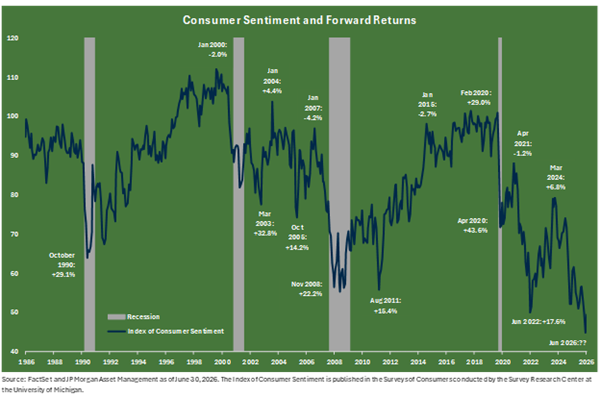
History has shown that successful investing depends less on reacting to short-term sentiment and more on maintaining a diversified portfolio aligned with long-term objectives.
The first half of 2026 reinforced a fundamental tenet of Sage’s investment philosophy: market regimes inevitably shift, and chasing past performance is an unreliable strategy. Market leadership broadened beyond a narrow group of technology companies.
Economic growth remained durable despite elevated interest rates, supporting small-cap stocks and helping them lead in the first half. Corporate earnings continued to anchor equity valuations. In each case, diversification was rewarded.
Several risks merit attention in the second half. Interest rates may remain higher for longer. Geopolitical or supply-related shocks could re-emerge. Federal Reserve policy is evolving under new leadership, and the AI investment cycle may continue to shift. These uncertainties are real, but in our view, they do not warrant significant changes to well-constructed portfolios.
Instead, these uncertainties reinforce the principles that guided us in the first half. Diversification across regions, sectors, and asset classes reduces reliance on any single outcome. When the future is constantly shifting, proactive planning and discipline are critical.
Footnotes
1 https://www.morningstar.com/business/insights/blog/us-fund-flows
Previous Posts
- Sage Insights: Rate Pressures, Earnings Strength, and the Case for Balance
- Sage Insights: Earnings Season Resilience Amid Gridlock in the Middle East
- Sage Insights: Markets, Geopolitics, and the Path Forward
- Sage Named Among Top Financial Advisory Firms
Learn More About Sage
Disclosures
The information and statistics contained in this report have been obtained from sources we believe to be reliable but cannot be guaranteed. Any projections, market outlooks, or estimates in this letter are forward-looking statements and are based upon certain assumptions. Other events that were not taken into account may occur and may significantly affect the returns or performance of these investments. Any projections, outlooks, or assumptions should not be construed to be indicative of the actual events that will occur. These projections, market outlooks, or estimates are subject to change without notice. Please remember that past performance may not be indicative of future results. Different types of investments involve varying degrees of risk, and there can be no assurance that the future performance of any specific investment, investment strategy, product, or any non-investment-related content referred to directly or indirectly in this newsletter will be profitable, equal to any corresponding indicated historical performance level(s), be suitable for your portfolio or individual situation or prove successful. Due to various factors, including changing market conditions and/or applicable laws, the content may no longer reflect current opinions or positions. All indexes are unmanaged, and you cannot invest directly in an index. Index returns do not include fees or expenses. Actual client portfolio returns may vary due to the timing of portfolio inception and/or client-imposed restrictions or guidelines. Actual client portfolio returns would be reduced by any applicable investment advisory fees and other expenses incurred in managing an advisory account. Moreover, you should not assume that any discussion or information contained in this newsletter serves as the receipt of, or as a substitute for, personalized investment advice from Sage Financial Group. To the extent that a reader has any questions regarding the applicability above to his/her situation or any specific issue discussed, he/she is encouraged to consult with the professional advisor of his/her choosing. Sage Financial Group is neither a law firm nor a certified public accounting firm, and no portion of the newsletter content should be construed as legal or accounting advice. A copy of Sage Financial Group’s written disclosure statement discussing our advisory services and fees is available for review upon request. Copyright 2026.