
The month of May unfolded against a backdrop of ongoing tension in the Middle East, where periodic disruptions near the Strait of Hormuz kept energy prices, inflation expectations, and higher rates in focus throughout the month.
In our view, markets are becoming less dependent on interest rate cuts as the primary driver of returns, and many businesses have successfully adapted to a higher-rate environment. Consequently, sustainable market momentum is now being driven by core operational strength, specifically robust economic growth and genuine corporate profitability.
Monthly Market Recap
Fixed Income Markets
Fixed income experienced positive performance in May, supported by a resilient global economy and stable corporate spreads, which helped counter interest-rate volatility, keep credit defaults low, and contain yields.
- U.S. taxable bonds gained 0.3% as investors closely watched incoming economic data for clues on the Federal Reserve’s next policy moves.
- U.S. municipal bonds rose by 0.4% as steady investor demand for tax-free income balanced out broader interest rate volatility during the month.
- High-yield bonds gained 0.5%, continuing to outperform investment-grade peers as resilient corporate earnings and stable economic growth kept credit spreads tight and defaults low.
- International bonds delivered 0.3% gains, experiencing volatility due to geopolitical dynamics around the world, including increased fiscal deficits, but ultimately benefited from a resilient global economy keeping yields contained.
Equity Markets
Global equity markets continued to march upward in May, driven by strong earnings growth, easing macroeconomic anxieties, and ongoing enthusiasm for technological innovation.
- U.S. large-cap equities advanced 5.3%, propelled by sustained momentum in mega-cap technology companies and a solid conclusion to the corporate earnings season.
- U.S. mid-caps rose 2.5%, driven by accelerating data center construction, which funneled immense capital expenditure into mid-sized industrial and technology firms providing critical power and cooling infrastructure.
- U.S. small-cap stocks gained 1.0%, underperforming their large-cap counterparts as higher-for-longer interest rate expectations kept borrowing cost concerns alive for smaller, more indebted companies.
- International large-cap stocks returned 5.0%, boosted by improving economic indicators in Europe and strong export demand.
- Emerging markets achieved a robust 9.7% return, leading all major asset classes due to significant rallies in Asian markets propelled by persistent global demand for tech hardware and semiconductors.

Understanding Pressure Across the Treasury Yield Curve
Bond yields are rising, but not for a single reason. Different economic forces are pushing rates higher at different points on the yield curve. Despite this, bond returns remained positive because strong coupon income and narrowing credit spreads helped offset price declines from rising interest rates.
Short End of the Curve
- At the short end of the curve, where maturities are typically two years or less, yields remain heavily influenced by expectations surrounding Federal Reserve policy. Those expectations shifted meaningfully throughout May as inflation proved more persistent than anticipated, particularly in energy, housing, and services.
- Markets steadily eliminated expectations for near-term rate cuts and even began pricing in the possibility of additional rate hikes later this year.
Middle of the Curve
- The middle of the curve, generally maturities between three and seven years, is shaped by the enormous capital demands tied to artificial intelligence infrastructure and digital expansion.
- As tech giants aggressively finance data centers, semiconductors, and power generation, this surging bond supply requires higher yields to attract investors. Consequently, intermediate-term yields may face persistent upward pressure even if inflation cools, signaling that today’s higher-rate environment is fueled by robust economic investment rather than weakness.
Long End of the Curve
- At the long end of the curve, yields continue to rise amid broader structural pressures within the Treasury market.
- The U.S. government continues to issue substantial amounts of long-term debt to finance persistent deficits. At the same time, the Federal Reserve is no longer a major purchaser of Treasury securities following the end of quantitative easing programs.
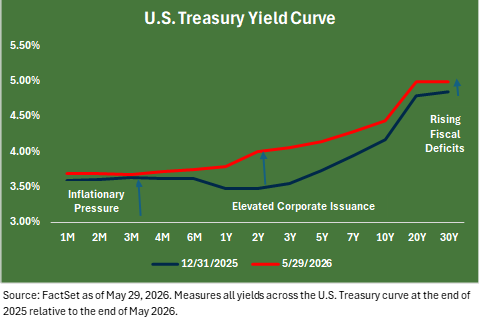
Given the stickiness of inflationary pressures, elevated corporate issuance, and rising fiscal deficits, these factors have collectively placed upward pressure on Treasury yields, creating a “higher for longer” interest rate environment.
Investment Implications
- For investors, this regime shift demands a fundamental rewiring of traditional fixed-income playbooks, as more interest-rate sensitive fixed income is expected to experience a prolonged period of price volatility.
- Sage continues to avoid the long end of the market, selectively using credit exposure to enhance portfolio income as risk management against interest-rate sensitivity.
Earnings Growth Remains the Primary Driver of Equity Returns
While higher interest rates continue to create challenges across markets, equity performance remains fundamentally supported by earnings growth rather than speculative enthusiasm.
The current investment cycle tied to artificial intelligence and digital infrastructure is still relatively early compared with prior technology booms. Although comparisons to the dot-com bubble of the late 1990s are common, we believe today’s environment differs in several important ways.
Most notably, corporate profits have largely kept pace with market performance. Since 2021, earnings-per-share growth for the S&P 500 has generally risen alongside stock prices. During the late stages of the dot-com boom, by contrast, stock prices rose substantially faster than underlying earnings, leading to a dramatic expansion in valuations. In the first quarter of this year, the S&P 500 achieved earnings growth of 27% year-over-year, which marked the 11th consecutive quarter of growth.
Today’s investment cycle is also supported by tangible infrastructure demand, including semiconductors, power systems, industrial equipment, utilities, transportation infrastructure, and data-center expansion. Much of this investment is being funded by companies with strong cash flows, high margins, and genuine capacity constraints rather than speculative business models.
That does not eliminate risk. Several large technology companies continue to drive a meaningful share of index-level returns, and many remain leaders in market performance. Additionally, the amount of debt used to finance data center expansion has increased over the past year.
We believe diversification across market capitalizations, investment styles, sectors, and geographic regions remains essential. Broad diversification helps reduce reliance on any single investment theme while positioning portfolios to participate across a wider range of economic and market outcomes.
Closing Thoughts
This past month reinforced two important realities for investors.
- Because interest rates may remain structurally higher, portfolio strategy cannot rely on a one-size-fits-all approach to managing risk and maximizing returns. Consequently, we believe investors must selectively use credit exposure to enhance portfolio income as a strategic buffer against interest-rate sensitivity.
- Corporate profitability continues to provide meaningful support for equity markets, even as borrowing costs stay elevated.
We continue to monitor several risks that could shift market trajectories, including renewed geopolitical escalation, persistent inflationary pressures, and the narrowing gap between Treasury yields and equity earnings yields.
However, at this time, none of these risks meaningfully change our approach and/or current outlook. Rather, they reinforce the value of preparing for a range of outcomes rather than relying on any single forecast.
In environments like this, diversification becomes less a defensive posture and more a recognition that markets are unlikely to follow a single path. Our strategy remains focused on balancing these competing dynamics through diversified positioning, active risk management, and an emphasis on quality across both equities and fixed income.
Previous Posts
- Sage Insights: Earnings Season Resilience Amid Gridlock in the Middle East
- Sage Insights: Markets, Geopolitics, and the Path Forward
- Sage Insights: Market Observations Beyond the Tech Giants
- Sage Named Among Top Financial Advisory Firms
Learn More About Sage
Disclosures
The information and statistics contained in this report have been obtained from sources we believe to be reliable but cannot be guaranteed. Any projections, market outlooks, or estimates in this letter are forward-looking statements and are based upon certain assumptions. Other events that were not taken into account may occur and may significantly affect the returns or performance of these investments. Any projections, outlooks, or assumptions should not be construed to be indicative of the actual events that will occur. These projections, market outlooks, or estimates are subject to change without notice. Please remember that past performance may not be indicative of future results. Different types of investments involve varying degrees of risk, and there can be no assurance that the future performance of any specific investment, investment strategy, product, or any non-investment-related content referred to directly or indirectly in this newsletter will be profitable, equal to any corresponding indicated historical performance level(s), be suitable for your portfolio or individual situation or prove successful. Due to various factors, including changing market conditions and/or applicable laws, the content may no longer reflect current opinions or positions. All indexes are unmanaged, and you cannot invest directly in an index. Index returns do not include fees or expenses. Actual client portfolio returns may vary due to the timing of portfolio inception and/or client-imposed restrictions or guidelines. Actual client portfolio returns would be reduced by any applicable investment advisory fees and other expenses incurred in managing an advisory account. Moreover, you should not assume that any discussion or information contained in this newsletter serves as the receipt of, or as a substitute for, personalized investment advice from Sage Financial Group. To the extent that a reader has any questions regarding the applicability above to his/her situation or any specific issue discussed, he/she is encouraged to consult with the professional advisor of his/her choosing. Sage Financial Group is neither a law firm nor a certified public accounting firm, and no portion of the newsletter content should be construed as legal or accounting advice. A copy of Sage Financial Group’s written disclosure statement discussing our advisory services and fees is available for review upon request. Copyright 2026.